# The Coat She Left on the Bus
PART 1
The morning my husband died, I found myself standing at a bus stop with twelve dollars in my purse and no idea what I was supposed to do next.
His name was Samuel.
He had been sick for almost a year, but somehow I had convinced myself there would always be another appointment, another treatment, another morning when he would open his eyes and complain about the coffee.
There wasn’t.
After the funeral, everything became paperwork.
Medical bills.
The mortgage.
Insurance forms.
A stack of envelopes I couldn’t bring myself to open.
I had stopped working during Samuel’s final months because he needed someone with him.
By December, my savings were almost gone.
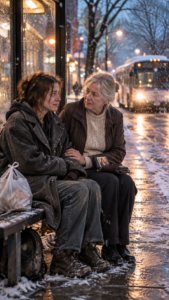
One cold evening, I left the hospital after meeting with a social worker and stood outside waiting for the number 14 bus.
Snow had begun falling.
That’s when I noticed the woman sitting at the end of the bench.
She was probably in her thirties.
Her shoes were soaked through.
She had a thin coat pulled tightly around herself, and beside her sat a small plastic grocery bag containing everything she owned.
I almost looked away.
Then she coughed.
A deep, painful cough.
“You’ll freeze sitting there,” I said.
She gave a tired smile.
“I’ve been warmer.”
I sat beside her.
Her name was Elise.
She had lost her apartment after falling behind on rent while caring for her mother. Her mother had died two months earlier.
We talked until my bus arrived.
Neither of us seemed ready to say goodbye.
Before stepping onto the bus, I took off Samuel’s wool coat.
It was the nicest thing I owned.
Dark gray.
Heavy.
Still carrying the faint smell of his cedarwood aftershave.
I held it out.
Elise stared at it.
“No.”
“Take it.”
“I can’t.”
“You can.”
She shook her head.
“That’s someone’s coat.”
“It was my husband’s.”
Her eyes softened.
“He passed?”
I nodded.
She touched the sleeve but didn’t take it.
“He’d rather you were warm,” I said.
Finally, she accepted it.
I pulled the collar around her neck myself.
It swallowed half her face.
She laughed for the first time.
“You don’t even know me.”
“No,” I said. “But I know what it feels like to lose everything in one season.”
The bus arrived.
I climbed aboard wearing only my thin sweater.
Before the doors closed, Elise called after me.
“What can I do for you?”
I smiled through the cold.
“Stay alive.”
I never expected to see her again.
I never expected that a woman I met for twenty minutes at a bus stop would become part of the story of my life.
But sometimes the smallest moments take longer to finish than we imagine.
—
PART 2
The winter was brutal.
There were nights when I ate toast for dinner.
There were mornings when I seriously considered selling the house.
But slowly, things changed.
A woman from the hospital helped me find part-time office work.
My neighbor began leaving extra groceries outside my door without saying where they came from.
Spring came.
Then summer.
Eventually, I learned how to live with the empty chair at my kitchen table.
Years passed.
I remarried.
Not because I stopped loving Samuel.
Because life had continued, and I finally allowed myself to continue with it.
I had two step-grandchildren.
I planted roses.
I traveled.
I learned to laugh again without feeling guilty.
But every winter, when the temperature dropped, I remembered the woman at the bus stop.
Elise.
I wondered whether she had found a home.
Whether she had found work.
Whether Samuel’s coat was still keeping her warm.
I never knew.
Then, twenty-four years later, I received a letter.
It came from a legal office in another state.
I almost threw it away.
The envelope was thick.
Inside was a short note.
**Mrs. Bennett,**
**My name is Rachel Moore. You don’t know me. My mother asked me to contact you before she passed away.**
**She said you might remember a woman named Elise who once sat beside you at a bus stop during a snowstorm.**
I stopped reading.
My hands went cold.
I sat down at the kitchen table.
Rachel’s letter continued.
Her mother had survived that winter.
The coat had helped her get through the coldest nights.
But more importantly, she had remembered what I said to her.
*Stay alive.*
She eventually found temporary housing.
Then a job washing dishes at a small restaurant.
She worked mornings and took community college classes at night.
Years later, she became a licensed nurse.
Then a hospital administrator.
Then she started a small foundation helping women who had lost housing while caring for sick relatives.
I read the letter twice.
At the bottom was one final paragraph.
**Mom kept your husband’s coat for twenty-four years. She repaired it three times. She said she could never throw it away because it was the first thing anyone had given her when she had nothing left to offer in return.**
I covered my mouth.
There was another envelope inside.
A photograph.
Elise stood beside a brick building with a sign above the door.
**The Samuel House — Emergency Housing and Family Support Center.**
My husband’s name.
I stared at it for a long time.
On the back of the photograph, Elise had written:
**I didn’t know his name that night. But you told me enough about him that I knew he must have been loved. I wanted to build something that would make his life matter to someone else.**
I cried then.
Not because I was sad.
Because twenty-four years earlier, I had given away a coat.
I had thought I was helping someone survive one cold night.
I had never imagined that the kindness would travel farther than either of us.
The final page of the letter explained why Rachel had contacted me.
Her mother had died three weeks earlier.
Before she died, she had left instructions.
There was something she wanted me to receive.
Something she had spent years preparing.
—
PART 3
Two months later, I traveled to the city where Elise had built her foundation.
Rachel met me outside the Samuel House.
She was around my age now.
She hugged me before saying hello.
“You really came.”
“I couldn’t not come.”
She smiled.
“Mom always said you would.”
Inside the building were families.
A mother helping her daughter with homework.
A young father carrying a sleeping baby.
An elderly man sitting quietly near a window.
There were small apartments upstairs, a communal kitchen, a laundry room, and offices where people helped residents find jobs and permanent housing.
On one wall were dozens of framed photographs.
People who had once lived there.
People who had moved on.
People who had rebuilt their lives.
Rachel led me to a small room at the end of the hallway.
There, hanging inside a glass case, was Samuel’s coat.
The wool was faded.
One sleeve had been patched.
The collar was worn smooth.
But I recognized it instantly.
Beside it was a brass plaque.
**For the man whose widow reminded my mother that tomorrow was worth reaching.**
I touched the glass.
“I never knew what happened to her.”
Rachel smiled.
“She never forgot you.”
Then she handed me a small wooden box.
Inside was a key.
And a letter.
I unfolded it.
Elise’s handwriting was shaky.
**Dear Nora,**
**If you’re reading this, I didn’t get the chance to thank you properly.**
**You gave me a coat, but that wasn’t the thing I remembered most.**
**You sat beside me.**
**You listened to me when nobody else seemed to have time.**
**You didn’t ask why I had failed. You didn’t ask how I had ended up there. You simply believed I was worth helping.**
**For years, I thought I was repaying you. Eventually I realized I couldn’t.**
**So I stopped trying to repay you and started passing it forward.**
**The key is to the apartment upstairs. Room 14. I bought it years ago and kept it empty for you.**
**If you ever need a place to stay, it’s yours. If you never need it, give the key to someone who does.**
**Either way, the kindness continues.**
I couldn’t finish the letter.
Rachel put her hand over mine.
“She wanted you to have a choice.”
I looked toward the glass case.
“I gave her a coat.”
Rachel smiled.
“She gave thousands of people a door.”
That evening, I walked upstairs.
Room 14 was small.
A bed.
A desk.
A little kitchen.
A vase of fresh flowers.
On the nightstand was a framed photograph of Samuel and me from our wedding day.
I laughed through my tears.
“She found this?”
Rachel nodded.
“Mom searched for years.”
I sat on the edge of the bed.
For decades, I had believed that the hardest part of losing Samuel was that his life had ended.
But standing there, surrounded by people who had never met him, I understood something I hadn’t expected.
His life had continued in ways neither of us could have imagined.
Through a coat.
Through a stranger.
Through one cold night.
Through every person Elise had helped afterward.
I kept the key.
Not because I needed the apartment.
I kept it because I wanted to remember that there had once been a night when I had almost nothing to give.
And I gave something anyway.
Before leaving, I returned to the hallway.
I stood beneath the photograph of Elise.
Then I whispered,
“Thank you for remembering.”
Outside, snow had started falling.
I pulled my coat tightly around myself and began walking toward the train station.
At the corner, I saw a young woman sitting alone beneath a shelter, rubbing her hands together to keep them warm.
I stopped.
For a moment, I thought about walking past.
Then I remembered a cold bus stop twenty-four years earlier.
I crossed the street.
“Are you all right?” I asked.
The woman looked up cautiously.
“No,” she said.
I sat down beside her.
And listened.